

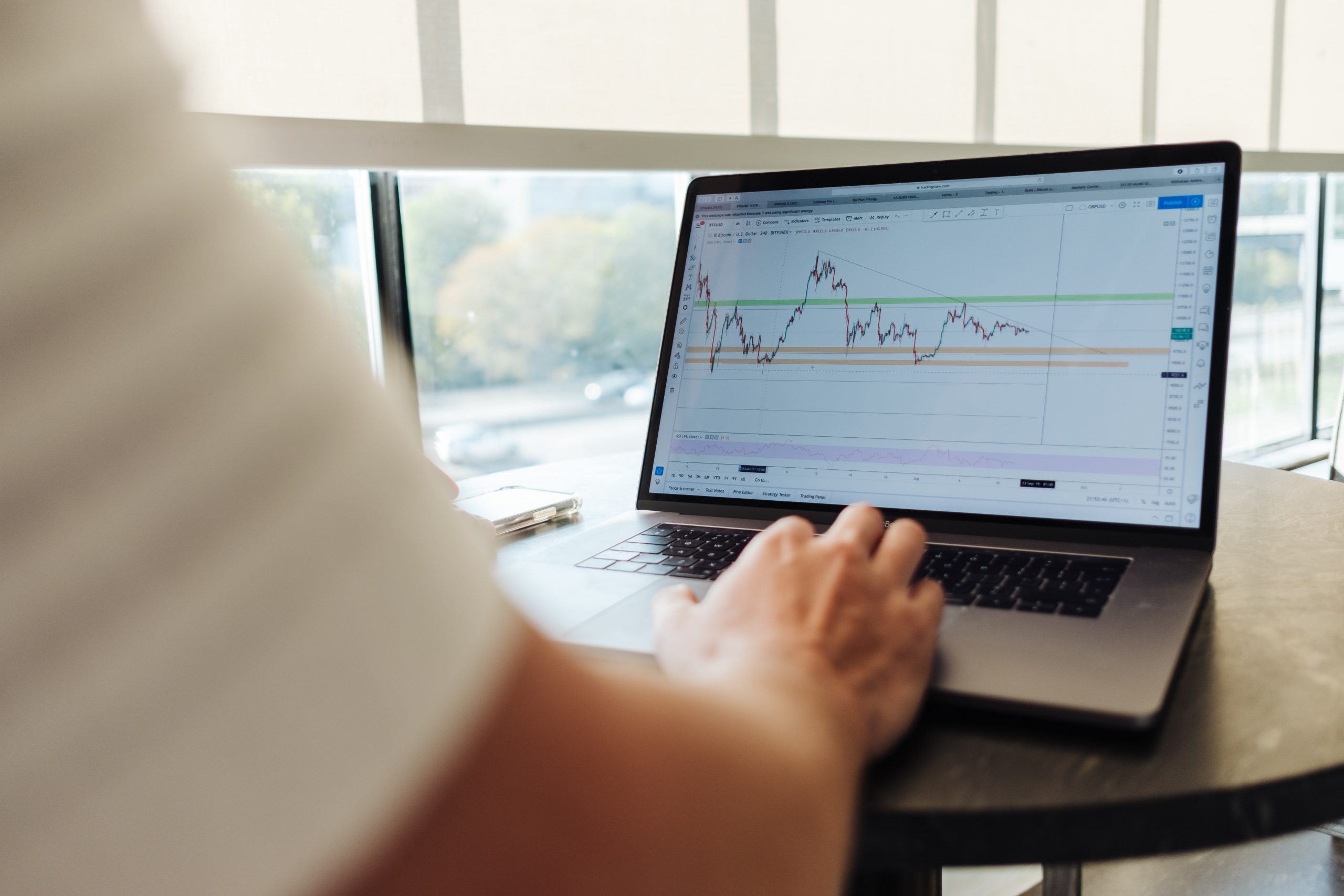
The best moving averages for swing trading can make or break your success rate. We’re going to help you weigh your options and elevate your trading strategy by talking about:
- SMA (Simple Moving Average)
- EMAs (Exponential Moving Average)
- SMMA (Smoothed Moving Average)
- LWMA (Linear Weighted Moving Average)
- MACD (Moving Average Convergence Divergence)
- DEMA and TEMA (Double/Triple Moving Average)
You also have to think about the ideal timeframe for your strategy; otherwise, even the best moving average for swing trading won’t provide the accurate, timely insights you need. Don’t worry, you’re going to feel confident implementing MAs into your swing trading strategy by the time you finish reading our guide below.
The truth is, though, there’s a better way to find opportunities and capitalize on them. VectorVest takes the stress, time, and guesswork out of stock analysis with a tried-and-true system that consolidates everything you need to know into a clear buy, sell, or hold recommendation.
Get the best iPhone stock app or Android stock app today!
Featured Courses:
Precision Swing Trading | Midas Touch Swing Trading | Swing Trading Success | Master Candlestick Analysis
What Exactly are Moving Averages?
A moving average is one of the best indicators for swing trading. It’s simply a calculation that takes the average price of a security over a certain period of time – and then plots that data on a chart. For example, if you’re looking at a 50-day moving average (MA), you’re essentially taking the past 50 days’ worth of closing prices and averaging them out. This gives you a good idea of the overall trend of a stock.
The Best Moving Averages for Swing Trading
There are different types of moving averages – as we briefly mentioned before. The most common ones used in trading are the SMA (simple moving average), EMA (exponential moving average), and MACD (moving average convergence divergence). However, there are quite a few others worth mentioning as well. We’ll break them all down below – starting with the SMA.
SMA (Simple Moving Average)
The SMA is the most basic type of moving average. As we briefly touched on, it simply takes the past X number of days’ worth of closing prices and averages them out. For example, if you’re looking at a 50-day SMA, you’re taking the past 50 days’ worth of closing prices and averaging them.
EMAs (Exponential Moving Average)
An exponential moving average (EMA) puts more weight on recent price action than a simple moving average does. The formula for an EMA includes a multiplier, which essentially determines how much weight is given to the most recent price. The larger the multiplier, the more weight that’s given to the most recent price – making it more responsive to recent price changes.
SMMA (Smoothed Moving Average)
A smooth moving average is simply an EMA that has had its multiplier reduced. This makes it less responsive to recent price changes than an EMA – but more responsive than a standard SMA.
LWMA (Linear Weighted Moving Average)
A linear weighted moving average (LWMA) is similar to an EMA in that it gives more weight to recent price action. However, the way the LWMA calculates weighting is different. With an LWMA, the weight given to each closing price declines linearly – as opposed to exponentially like with EMAs.
MACD (Moving Average Convergence Divergence)
The MACD is a bit more complex than a simple moving average or EMA. It’s actually the difference between two exponential moving averages – the 26-day EMA and the 12-day EMA. MACD lines are plotted above and below a zero line, which signals bullish and bearish momentum, respectively.
DEMA and TEMA (Double/Triple Moving Average)
The double and triple moving averages help reduce the lag that shows up in traditional moving averages.
A DEMA uses a combination of an EMA and a second EMA applied to the first, producing a faster response to price changes. TEMA takes this a step further by layering three EMAs into one calculation.
You can use these when you want a smoother line that reacts quickly without the choppiness of very short-term averages. These are some of the best moving averages for spotting early shifts in trend or confirming momentum on charts where standard EMAs feel too slow.
Other Moving Averages to Know
There are quite a few other types of moving averages we could touch on – including the Hull Moving Average (HMA), Kaufman’s Adaptive Moving Average (KAMA), Vidya’s Linear Regression Slope (VLSM), and many others. However, we don’t want to get too far into the weeds. The purpose of this article is to help you discover the best moving averages to use for swing trading – so with that said, let’s break down the pros and cons of each style.
Which Moving Average is BEST for Swing Trading?
You could make the case for any of these as the best moving averages for swing trading. If we had to pick just one, though, which moving average is BEST for swing trading? The answer isn’t as simple as you might hope.
The best moving average for swing trading depends on your trading goals and risk tolerance. In general, exponential moving averages (EMAs) are a good choice – as they’re more responsive to recent price action than simple moving averages (SMAs).
Keep the moving average length in mind. A longer moving average will smooth out some of the noise and help you better identify the overall trend. Conversely, a shorter moving average will be more responsive to recent price changes – which can be helpful if you’re looking to enter or exit a trade quickly (as most swing traders are). We’ve found the best time frame for swing trading is a 20-day moving average or a 50-day moving average is another great option. Speaking of time frames…
How Time Frames Factor Into Moving Averages
Just as there are different types of moving averages, each of these can be broken down further by time frame. We wrote a complete guide on which time frame is best for swing trading if you’d like to learn more. However, we’ll touch on the basics here. There are three main time frames to consider when swing trading: short-term, intermediate-term, and long-term.
Short-Term Moving Averages
A short-term moving average is any MA that has a time frame of 20 days or less. The most common MAs used in this time frame are the 50-day, 100-day, and 200-day MAs.
Intermediate-Term Moving Averages
An intermediate-term moving average is any MA with a time frame of 21 days to 200 days. The most popular MAs in this category are the 100-day, 150-day, and 200-day MAs.
Longer-Term Moving Averages
A long-term moving average is an MA with a time frame of 200 days or more. The most common ones used by traders are the 200-day and 300-day MAs.
Common Moving Average Combos/Setups for Swing Trading
You know the best moving averages for swing trading and you even understand the time frame side of things. But now we want to add another layer to show you how the most successful swing traders use these – more specific setups that work for short-term trades.
9/21 EMA Pullback Setup
This is one of the cleanest ways to trade a trending stock. The 9-EMA tracks short-term momentum, while the 21-EMA reflects the broader swing trend. A lot of traders look for a bounce as their entry when price pulls back into the 21-EMA during an established uptrend and holds, many traders look for a bounce as their entry.
20 SMA With 50 SMA Trend Filter
The 20-SMA reacts fast enough for short-term trading, while the 50-SMA acts as a filter for the larger trend. You’re working with bullish conditions anytime the 20 is above the 50. When it’s below, the bias leans bearish. Entries often come from price returning to the 20-SMA while the 50-SMA confirms direction.
50/200 SMA Golden Cross & Death Cross
The classic Golden Cross (50-SMA climbing above the 200-SMA) signals long-term momentum shifting to the upside. The opposite – the Death Cross – signals momentum turning lower. You should have both in your toolkit as a swing trader to identify high-probability environments and avoid fighting major trend shifts.
10 EMA + Price Reclaim Setup
Some traders keep it simple: they track whether price is above or below the 10-EMA. Look out for a stock pulling back, undercutting the 10-EMA, and quickly reclaiming it – that shows you a possible entry point. We love working with this setup for tight pullbacks and strong momentum.
How to Use Moving Averages for Swing Trading
Now that we’ve answered the question – what are the best moving averages for swing trading? – it’s time to show you how to actually use them. Moving averages can be used in a few different ways when swing trading. We’re going to touch on three of the most popular methods below.
Identify the Overall Trend
The first way to use moving averages is to simply identify the overall trend. This is probably the most common way that MAs are used by traders. By plotting a MA on your chart, you can quickly see whether a stock is in an uptrend, downtrend, or sideways pattern.
An uptrend occurs when the stock is making higher highs and higher lows. In other words, each successive peak and trough is higher than the last. A downtrend is the opposite – with the stock making lower lows and lower highs. And, finally, a sideways or range-bound market occurs when the stock isn’t making any clear directional moves – it’s just bouncing around between support and resistance levels.
Time Your Entry
Once you’ve identified the overall trend, you can use moving averages to help time your entry into a trade. For instance, let’s say you’re looking at a stock in an uptrend that suddenly starts to pull back towards its MA. This could be an opportunity to buy the dip – as long as the MA holds as support. Conversely, if a stock in a downtrend starts to rally back up towards its MA, this could be a good time to sell or short the stock.
The key here is to wait for confirmation before taking a trade. In other words, don’t just blindly buy or sell a stock every time it touches its MA. Instead, look for candlestick patterns or other indicators that signal that the trend is still intact – even after the pullback. This will help you avoid false breakouts and increase your chances of success.
Exit Your Trades
Moving averages can also be used to help you exit your trades – either at a profit or a loss. For example, if you’re in an uptrending stock and the price starts to drop below its MA, this could be a sign that the trend is reversing and it’s time to get out. Similarly, if you’re in a downtrending stock and the price starts to move back above its MA, this could be a sign that the trend is losing momentum and it’s time to take your profits.
Of course, it’s always best to use other technical indicators in conjunction with MAs to confirm your exit signal. For instance, you could wait for the RSI indicator to become overbought or oversold before taking action. Or, you could look for candlestick patterns like bearish reversals or bullish reversals.
A Simpler Way to Find Opportunities, Entries, & Exits Without Manual Analysis
Even using the best moving averages for swing trading can become time-consuming, complicated, and at times, inaccurate. Fortunately, there is a better way to conduct analysis that requires no manual work on your end. You can effortlessly find opportunities and identify entry/exit points – no guesswork, no emotion. Just sound investment principles that have been perfected over the course of the past decades. Sounds too good to be true? It’s not – our stock analysis software is the #1 resource for investors looking to simplify things while earning better returns.
The VectorVest system boils down all fundamental and technical analyses into three proprietary ratings: Relative Value, Relative Safety, and Relative Timing. These make up the VST (value, safety, timing) rating a stock is given. All of these ratings are easy to understand, ranked on a scale of 0.00-2.00. The closer to 2.00, the better a stock is performing against the average. And, this system provides investors with a clear buy, sell, or hold recommendation for any given stock. You can still use technical indicators – like moving averages – to help validate opportunities and time entries/exits. But, the point is that you don’t have to. Wouldn’t it be nice to earn more profits while spending less time in front of a screen? That’s the value behind VectorVest.
Our system also grants investors insights into what market sentiment is at any given time. With prebuilt searches for the hottest stocks at any given time, finding your next opportunity is as straightforward as it gets. You can even take your investments on the go with our mobile stock advisory. Want to see it in action? Get your free stock analysis here!
Final Thoughts on the Best Moving Averages for Swing Trading
So, which moving average is best for swing trading? In our opinion, you can’t beat the 20-day or 50-day SMA or EMA. These give swing traders all the insights they need to uncover trends and find the perfect entry/exit point.
And while using the best moving averages for swing trading can be beneficial, there is an easier, more straightforward way to trade. With VectorVest, you don’t have to spend nearly as much time staring at charts. And you’ll enjoy a greater rate of success along the way. What more could you ask for?
See how our solution compares to others on the market in our articles talking about Seeking Alpha vs Morningstar or Motley Fool vs Seeking Alpha. Otherwise, it’s time to set yourself up for success with VectorVest!
Featured Courses:
Precision Swing Trading | Midas Touch Swing Trading | Swing Trading Success | Master Candlestick Analysis
Frequently asked questions
What is the best moving average for swing trading?
There’s no single best moving average for swing trading. That said, the 20-SMA, 21-EMA, 50-SMA, and 9-EMA are the most commonly used for their balance of speed and reliability.
Should I use the SMA or EMA?
Use the SMA when you want a smoother read on the broader trend, and the EMA when you want faster feedback on short-term momentum. They both have their place.
How does strategy shift for spotting trends compared to timing entries?
Longer moving averages help you confirm the trend direction, while shorter ones help you pinpoint the pullback or breakout you want to trade.
Do moving averages serve as support or resistance lines?
They CAN be dynamic support or resistance when a trend is clean, but you should always confirm the reaction with price action or volume.
What is the golden cross?
A golden cross happens when the 50-SMA moves above the 200-SMA. This is a signal that a shift is underway – moving towards long-term strength.
What about the death cross?
The death cross is the opposite of the golden cross. When the 50-SMA drops below the 200-SMA, you can reasonably assume long-term momentum is weakening.
How do I prevent myself from falling victim to false signals?
Even the best moving averages for swing trading can lead you astray. Pair moving averages with price action, volume, or another indicator so you’re never acting on a single line crossing alone.
Better yet, stick with a more tried-and-true system like VectorVest. It’s the #1 choice for uncovering your swing trading stock picks, and it even works well for finding the best stocks for covered calls or the best stocks for Roth IRA.
VectorVest has outperformed the S&P 500 index by 10x over the past 20 years. See what it can do for your portfolio – start your trial today!




Leave A Comment